
Why we feel lonely and empty
And how prehistoric humans can help us solve it.

Music came to humans before language.
Humans were exposed to birdsong, whistling winds, and the sounds that erupt from old hollow bones before they could comprehend words. So they were cooing to babies and vocalizing their love and their hurt before they said a single word. Structured language came later as a more precise tool for conveying information. A well-accepted hypothesis is that language is better understood as a special kind of music. Humans learned to say I love you, and Your beauty is overwhelming, before they learned to say You owe me eight goats by Monday.
Today all we ever talk about are goats and Mondays.
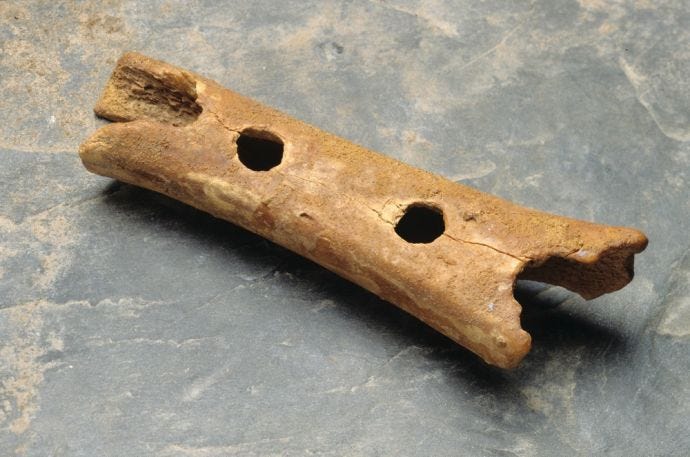
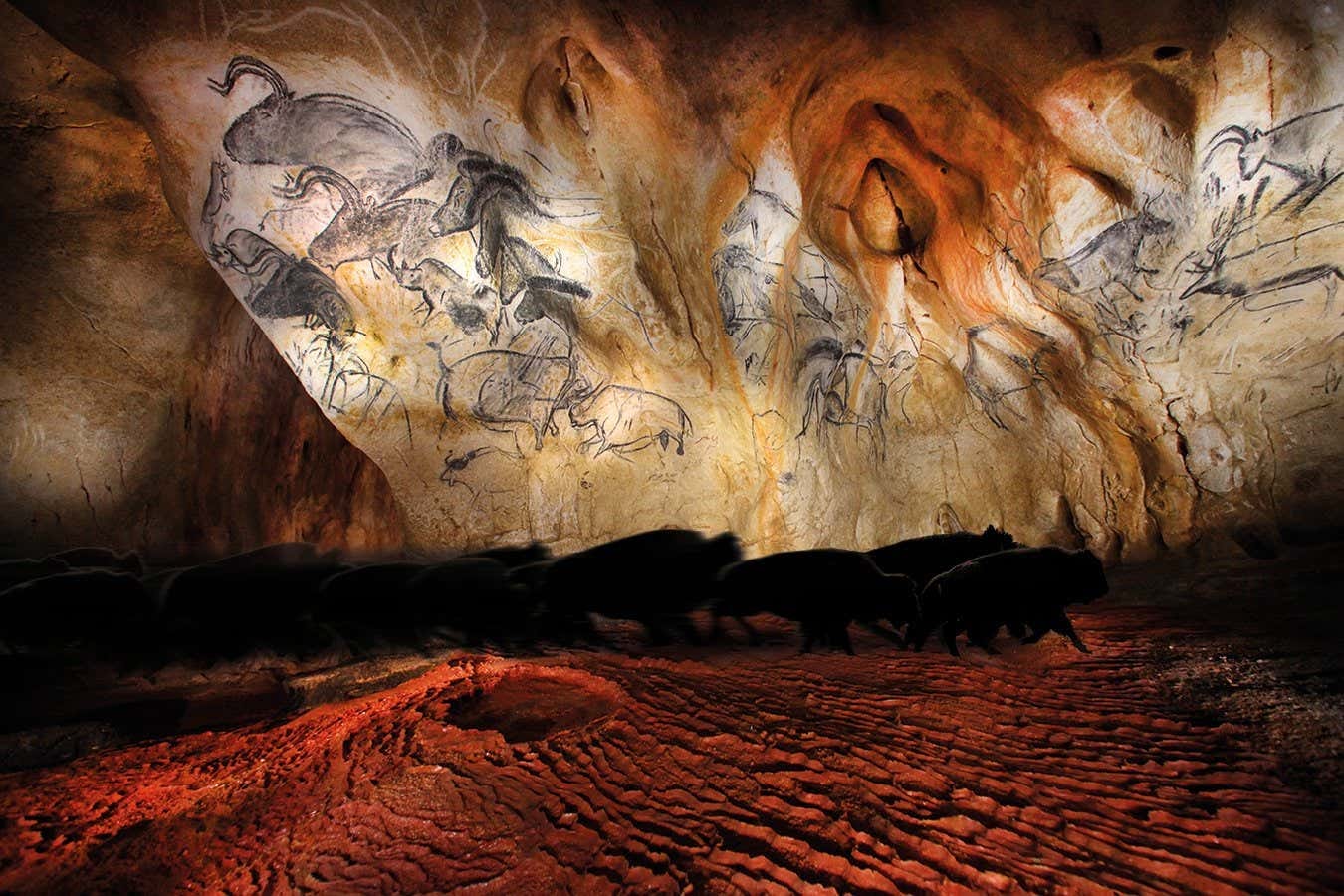
Archeologists find surprisingly sophisticated musical instruments in prehistoric human settlements as far back as 60,000 years ago. The rock art made by ancient humans was not randomly placed. It was found in the parts of caves with the best acoustics — chambers that produce strong low-frequency, chest-filling vibrations and a long decay, much like the acoustics in a modern concert hall. Cave art was not a lonely doodle scratched into a wall. It was part of a ritual display, complete with a flickering fire that animates the art, drumming, singing, and perhaps a flute made of bear thigh bones.
There is also prehistoric art that documents the night sky. There were practical reasons for reading the stars — navigation, tracking seasons, keeping time. But these people had a view of the Milky Way that few humans alive today can see. They watched the universe turn around them as they sat around their campfires, timing celestial events with the seasonal behavior of plants and animals, recording shooting stars and the waning moon. The night sky was more than information. It was awe.
There is consistent archaeological evidence that the people who sat around these fires were capable of extraordinary empathy, altruism, and social cooperation. Skeletal remains of children with Down’s syndrome, brain defects, and spina bifida show evidence of sustained care and protection by the group. A 45,000-year-old Neanderthal man with a severe limp, a crushed arm, and partial blindness lived into his forties. He could not have survived alone. Someone — many someones, over many years — kept him alive.
These people were equal to modern humans in cognitive ability and emotional depth. They figured out how to survive in a world they knew almost nothing about. They persisted through famine, disease, and death. So much death.
900,000 years ago, our ancestral hominin population collapsed to fewer than 1,300 fertile individuals. This was not a brief crisis. This was the total global population for more than a hundred thousand years, through prolonged drought and extreme environmental instability. These were not yet modern humans, but the research supports that it was during this period that they developed the capacities that make us human today: complex social bonds, theory of mind, a disposition for storytelling. Every person alive today descends from those 1300 survivors.
There was another near-extinction 74,000 years ago — the Toba event. A supervolcanic eruption in what is now Sumatra triggered a volcanic winter lasting years. Genetic evidence suggests the human population may have crashed to as few as 10,000 individuals. This period coincides precisely with when what we call behavioral modernity seems to consolidate in the archaeological record. Symbolic thinking. Complex tools. Long-distance trade in materials.
Each time humanity was pushed to the edge, something essential crystallized in us.
We are the descendants of the survivors of multiple catastrophic filters spread across millions of years. We carry in our genes the compressed memory of every time we almost didn’t make it. We also carry, coded into us, the resilience and the creativity and the capacity for love and beauty that sustained us while we persisted through impossible circumstances.
Art, beauty, and community were not a hobby on the side of survival. They were the mechanism of survival.
![Some of the world's oldest cave paintings have revealed how ancient people had relatively advanced... [+] knowledge of astronomy. Animal symbols represent star constellations in the night sky, and are used to mark dates and events such as comet strikes, analysis from the University of Edinburgh suggests. (Credit: Alistair Coombs)](https://substackcdn.com/image/fetch/$s_!21rY!,f_auto,q_auto:good,fl_progressive:steep/https%3A%2F%2Fsubstack-post-media.s3.amazonaws.com%2Fpublic%2Fimages%2F5b998a8d-fc0e-4415-a086-5cff971ea14b_1440x960.jpeg "Some of the world's oldest cave paintings have revealed how ancient people had relatively advanced... [+] knowledge of astronomy. Animal symbols represent star constellations in the night sky, and are used to mark dates and events such as comet strikes, analysis from the University of Edinburgh suggests. (Credit: Alistair Coombs)")
The cave paintings documenting the night sky were navigational records for migrations across thousands of miles. The ability to see beauty and value in the sick and the injured — to collectively care for them — is what brought us out of near-annihilation. Pitch, melody, and rhythm carried the emotional information that language had not yet evolved to carry. The ritual, the gathering, the shared resonance of a chest-filled chamber: these were the technologies of cohesion that kept small terrified groups from dissolving into nothing.
We know this because we keep finding the evidence. And because we keep looking for it — in them, and in ourselves.
Today we are consistently fed and sheltered, at a price. We are stacked on top of each other in cities designed for efficiency over beauty. We commute for hours to perform jobs that feel paradoxically both stressful and meaningless. We spend the majority of our waking hours making enough for rent, groceries, and a stream of stuff that overtake whatever mental space is left. We return home to devices that reward comparison and manufacture conflict.
There is no reverence in our daily rituals. There is a pervasive disconnection, even within families. Mystery and creativity are treated as indulgences. Net worth, follower counts, weight, daily steps — the things that can be measured have become the definition of a life.
For a long time, mystery and measurement, faith and observation, were not in competition. The sacred and the scientific could not be separated because people did not think to separate them. The person mapping the stars was also inside an experience of awe. Both were real. Both were true.
Then came a hinge point. A moment when the way we understood the world shifted permanently toward the quantifiable. Galileo made a philosophical claim that would slice reality into two halves: that the real properties of the world were the ones you could measure. Size, shape, mass, speed — real. Everything that could only be felt — the resonance of a gong in the chest, the ache of a minor key, the brief experience of eternity when looking at a sky full of stars — was merely the mind’s reaction. Subjective. Secondary. Not quite real.
And so knowledge and experience were parted.
We’ve been enormously productive since. We made physics, chemistry, medicine, satellites, the ability to predict what falling into a black hole would be like. We cured diseases that had killed millions. We connected every person on earth to every other person. These are important things. These are things that should make us proud.
We also, without intending to, devalued inner experience. Creativity became a luxury. The result is a particular kind of emptiness and loneliness. It’s not dramatic. Just the low hum of something necessary going unmade.
Our inner experience has a formal name in philosophy: qualia. These are the what-it’s-like dimensions of being alive — the redness of red, the sweetness of a child falling asleep on your chest, the ache of longing. Galileo excluded qualia from scientific description precisely because they resist quantification. They cannot be summarized. They can only be transmitted through direct experience.
So while we can predict within inches where an asteroid will be a hundred years from now, we still need a novel to explain what it feels like when a parent dies. We need a film score to carry the bittersweet weight of young love. Because qualia are not transferable through any other means. There is no formula for grief. There is no instrument for the specific quality of missing someone. You can only recreate the conditions under which another person might feel their way toward something adjacent to what you felt.
Art is the technology we built to describe the only data that science cannot touch.

Which brings us back to the ancient caves.
Their tribe has been reduced to just about twenty people. Their medicine man, older than memory, has a rattling cough that keeps getting worse. They are all gaunter than they have ever been.
A baby died today. The only one born in years.
They gather in the cave after the burial, depleted and lost, unable to bear the horror of the day. They light a fire. It doesn’t help. They sit around it in silence.
A woman makes a sound, a tremulous tune that breathes through a bear thigh bone that she found years ago. She has carefully whittled holes into it, learning its pitch and cadence until it feels like an extension of her body. Tonight, grief pours out of it and fills the cave. It is punctuated by the sobs of the mother who was catatonic throughout the burial. A cousin brings out a drum made of animal hide stretched over a coconut shell. He keeps time with her.
The flute’s grief rises thin and searching, and the drum meets it from below — steady and patient, like a heartbeat. They do not blend. They braid. The sound shifts. They are still sad. But they are sad together, which is a different thing entirely.
They are surrounded by the sketches of their hunts on the walls around them, reminding them that the land has provided for them before, and will again. A man starts to hum along, a song he half remembers from childhood. Others join in, the melody a memory of an innocent time.
They step out again and look up. The stars are there. Grief and loss are there still, but tinged with something that is not quite hope. Not yet. Maybe faith.

The person standing in that chamber 40,000 years ago, feeding the bone flute with her lungs, was not doing something separate from survival. She was doing survival.
She was keeping the group coherent. She was transmitting what could not be said. She was locating herself in something larger than fear, and taking everyone in that chamber with her.
Humans need to create. Rational thought takes us far, but it deals in what can be verified — true and false, measurement and projection. Large portions of human experience — grief, belonging, dread, and longing — resist this form entirely. We need to channel what’s inside us. A feeling, a pressure, a confusion, a joy we can’t quite hold. We need to find a form for it in the world. So there is a chance that someone else recognizes it, and it, briefly, doesn’t belong to only us.
Humans need beauty. Beauty is the mind’s way of recognizing coherence. A face, a proof, a sentence, a skyline that feels like it fits. It interrupts the ceaseless self-maintenance of the thinking mind and draws attention outward. For a moment, something outside the self takes up space. This, philosophers across traditions have argued, is pretty important. Really seeing something that you are drawn to — paying close, patient, honest attention — is the same capacity required for genuinely seeing another person. Aesthetic attention and ethical attention share a common root.
Humans need community. Not group chats and curated feeds. The kind built through physical presence and shared friction and the slow accumulation of being known. The kind that kept a limping, half-blind Neanderthal alive for decades because his community could not abandon him.
We need art, beauty, and community the way we need protein and sleep. It is basic maintenance of what we are. We evolved into these minds and psyches across millions of years of survival that depended on them. We cannot simply graze and optimize and commute and scroll and expect to remain intact. We will not collapse dramatically. We will just slowly hollow out, in ways we can feel but struggle to name. Listlessness. Disconnection. Unplaceable rage.
Each time humanity was pushed to the edge, something essential crystallized in us.
We are at an edge now. It does not announce itself like a volcanic winter or a hundred thousand years of drought. It arrives in the specific texture of modern life. A man on a train, headphones in, surrounded by a hundred people, completely alone. A child who has never been bored. The feeling that comes on Sunday evenings that no amount of productivity or entertainment quite reaches. We reach for our phones. For a drink. For another delivery, another distraction, another optimization of the hours. It is not working.
What crystallized in our ancestors was not strength in the way we usually mean it. It was not resilience as self-improvement. It was the discovery that what makes the darkness survivable is not endurance alone. It is the turning toward. The making of something. The sound one person starts and others, helplessly, join.
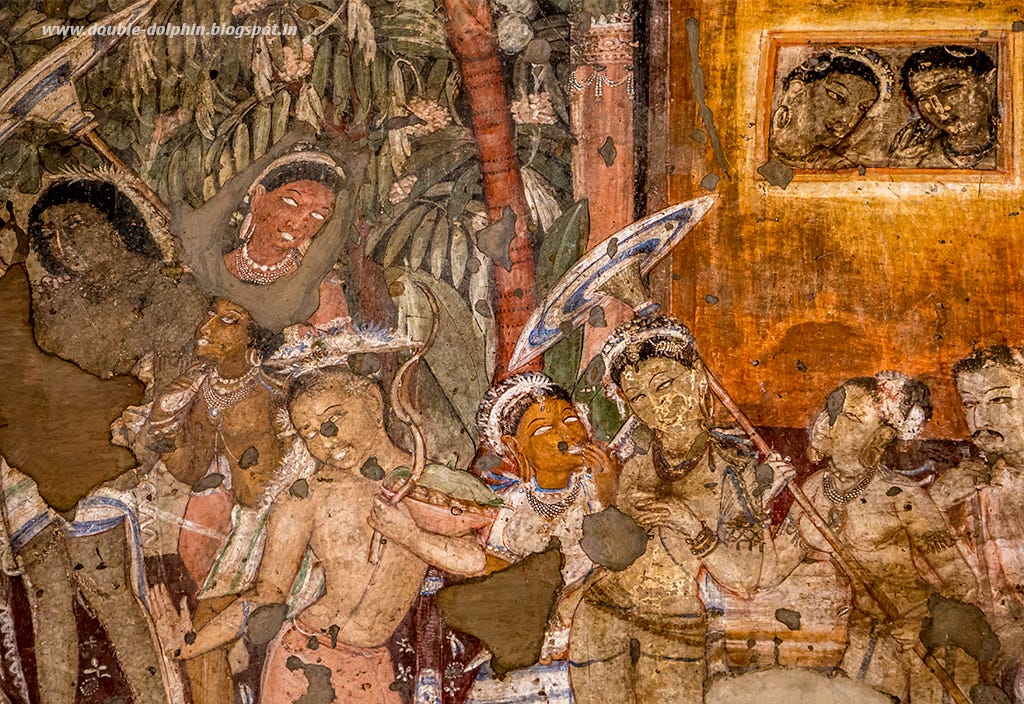
So let’s find our way back to it. Not as self-improvement or content. But as the thing our ancestors reached for when everything else was stripped away and only the essential remained. Let what is inside you find a form in the world. So there is a chance that someone else recognizes it. So it, briefly, doesn’t belong to only you.
That is what we were built for. That is what brought us here. That is what will carry us forward, if anything will — not the next optimization, not the next productivity system, not the next distraction from the hollow feeling, but the oldest technology we have.
The tune. The drum. The hand pressed against wet stone.
I was here. I felt this. Does anyone else?
I had restacked to read later. This is some research. Kudos.