
Does water remember being older than the sun?
A meditation on the history, science and mythology of water.

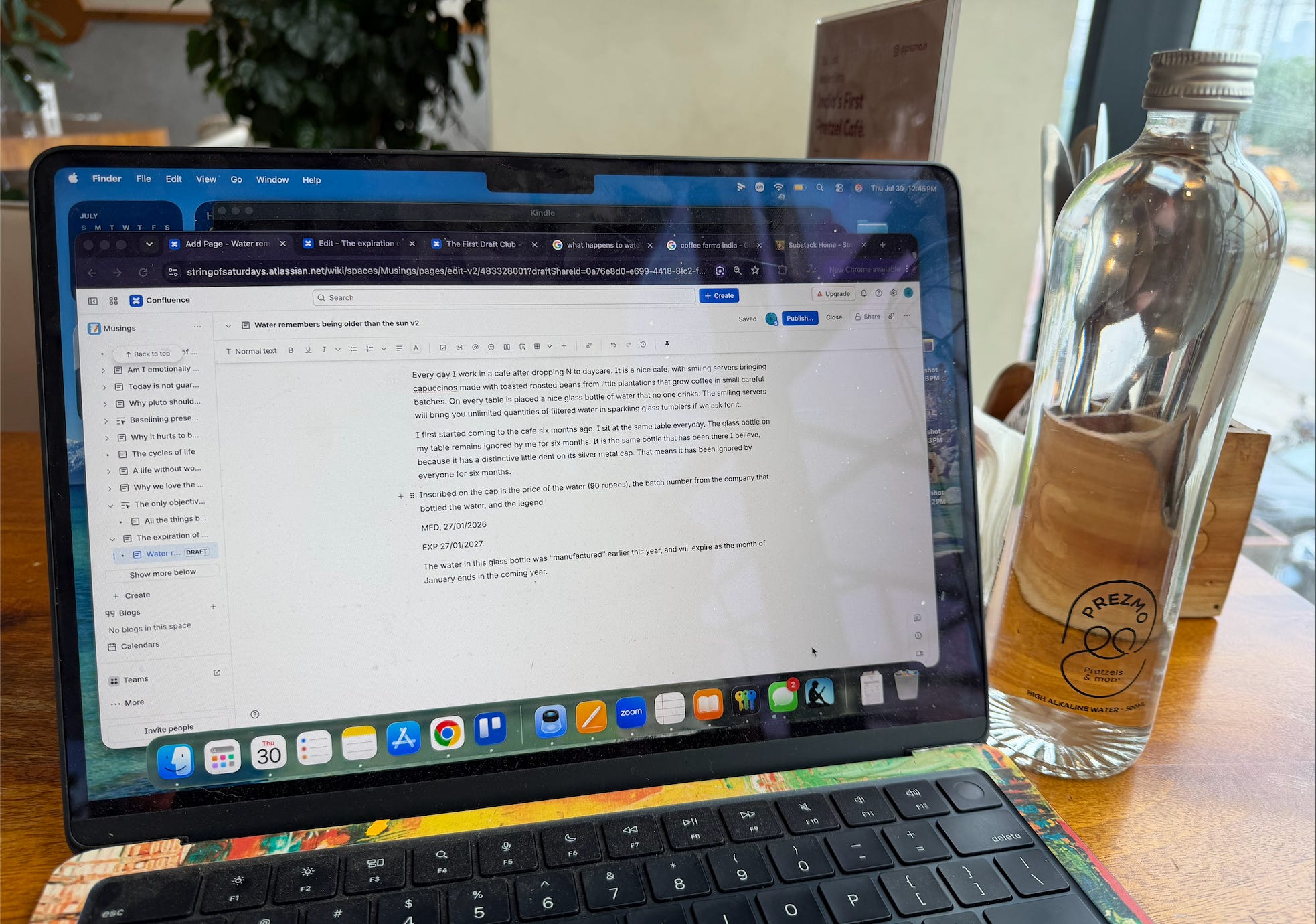
Everyday, I work in a cafe after dropping N off to daycare. A nice cafe, with luxurious plants clustered next to bright glass windows, and smiling servers who remember how I like my tea. The place smells like roasted coffee beans from small careful batches grown in local plantations. On every table is placed a glass bottle of water that no one drinks despite the Hyderabad heat. The smiling servers will bring you unlimited quantities of filtered water in sparkling glass tumblers if we ask for it.
Six months now I have sat at the same table and looked past the same bottle. It has a small dent in the silver cap, the kind a bottle gets on a conveyor belt somewhere before it ever meets a person. On this cap is a printed legend that emphatically states that this bottle of water was manufactured precisely on January 28th of 2026 and will expire on January 27th of 2027. Because of that dent I know it is the same bottle, ignored today the way it was ignored in February, in March, in April, in every month I did not touch it.
The age of water
This is what we know about the age of water. It is, at the very least, four and a half billion years old, about as old as Earth. But it is entirely possible that water on Earth was not formed here at all.
It is speculated that Earth was born bone dry, in a solar system that was at the time too hot for water. For the longest time, scientists believed that water on Earth was born through primordial hydrogen and oxygen atoms that joined to make ice crystals in deep space clouds many billion years before the Sun ignited. For eons they swirled and drifted in cold, black nurseries between the stars, and were delivered to us in comets and asteroids and other wandering space travelers. A hundred million years after the sun caught fire, water flowed on Earth. That is fast on the clock the universe keeps.
Then in 2025 – practically yesterday in a cosmic sense – someone cracked open a 4.5 billion year old rock, and the tidy story cracked a little. Maybe Earth made water for us from its own hydrogen-rich body.
The reality is probably a hybrid of both theories. The water on Earth is not isotopically uniform. We probably drink and clean and bathe in two kinds of water. Some home grown right here on Earth, and the rest as ancient as the universe itself, borrowed from very far away. The two are indistinguishable now, mixed forever in every body, in every bottle.
The memory of water
In every culture on our planet, there persist myths about water carrying memory and emotions.
In ancient traditions, water was considered a foundational element, one of the four roots of existence – earth, water, air, fire. Aristotle assigned each element qualities. Water is cold and wet. Water is malleable, formless, and has the capacity to take the shape of whatever contains it.
The elements were mapped onto the zodiac. The water signs – Cancer, Scorpio, Pisces – are characterized by receptivity, depth, attachment, and intuition. Water signs are changeable and emotional, unlike the intellectual detachment of air, the assertive drive of fire, or the patient groundedness of earth.
In Vedic traditions, water symbolizes purity, the natural flow of life towards divinity, and the surrender of ego. It is the medium through which the living honor the dead. The river Ganga specifically is understood as the portal through which ancestors pass safely after death. The sipping, sprinkling, and pouring of water, the bathing, cleansing, and dipping in water – these are not just symbolic rituals, but rehearsal for the absolute inevitability of impermanence: practicing, drop by drop, both the taking in and the letting go, until one day we have to let go of everything all at once.
Carl Jung explicitly picked the water symbol as the universal archetype for the unconscious itself. Across the world, across cultures and nations, dreams of oceans, wells, rivers, or floods represent emotional material rising up from below conscious control.
French immunologist Jacques Benveniste ran a study where he “proved” that water once dissolved with a substance contained a “memory” of the substance, a theory that is foundational to the practice of homeopathy to this day.
Then Japanese scientist Masaru Emoto made the leap from “water remembers substances” to “water remembers emotions”. In the 1990s, Emoto claimed that water crystals could change shape based on words, music, and images. His famous water and rice experiment is immortalized in pop culture. He kept three jars of rice and water, where he spoke “Thank you” to one, “You idiot” to another, and ignored the third. The water that was shown kindness allegedly structured itself into beautiful shapes, while the water in the ignored jar was made jagged and ugly.
So it is hardly surprising that the idea of water holding emotions is imprinted in modern culture. In the movie Frozen 2, the idea that water retains the history of everything it touches and everyone it passes through is a major magical plot point.
Of course, none of these myths and theories have any scientific backing. None of it holds up. Not one page of it. The memory of water is a stubborn, persistent myth that no one believes, even though we live our lives drowning in grief, flooded with relief, boiling with anger and hacking ourselves into flow state.
The life of water
We believe ourselves to be proper, modern materialists. We don’t believe in magic and in spirits. Maybe we did, when we were little, but we know that the universe is impersonal, governed by impartial laws of physics that remembers no one and nothing. And yet we treasure old handmade things, have relationships with and attachments to homes and cars. We are sure a machine hates us when it refuses to serve us, a half conscious belief that its behavior is intentional.
Whether we like it or not, we are creatures built from feeling and myth-making. We reach for magic the way a plant reaches for light.
It took millenia of thinking and advancement to find water’s chemical formula, but we never had to learn to find awe at the sight of the ocean. Millennia of us, standing at the edge of water, saying nothing, feeling something that has no words. We need water to keep us alive. And being what we are, we need it to mean something too.
This particular bottle of water has been on my table everyday for six months. I have ignored this bottle for six months. It is stamped with the assertion that in the next six months, this primordial thing, at least four-and-a-half-billion-year-old, will expire. The way milk does, the way a body does. Does the water know about this judgement? Do its molecules become ugly as I sit next to it, day after day, ignoring it?
Today I am overwhelmed with the irrational, animistic sensation that this particular bit of water is restless. It has touched ancient lands, flowed in the veins of millions of our ancestors. It was forged in the scorching fires of ancient Earth, and crystallized in the boundless void of deep space. It flew and flowed to find a feeling creature and live in it and churn within it and rush out in spurts through a beating heart.
Today I invite this particular piece of cosmic fluid into myself for the price of 90 rupees, just a little less than a dollar. Today it will know what it’s like to be me. Today it will dissolve with the caffeine and sugar from a cup of tea I will nurse as I finish writing this piece. It will taste the metal in the gym dumbbells, and hear about S’s day when I get back home, and watch N’s antics at the park, before she nestles into me before she turns in for the night, and flow into her through my breast, and finally, finally, it will feel something.
A lovely meditation on the essence of water.